
Crypto Wallets Explained: Custodial vs. Non-Custodial
- Dec 17, 2025
- 2 min read
Crypto wallets play a critical role in blockchain development, decentralized applications, and digital asset infrastructure. They enable users to store cryptocurrency, sign transactions, and interact with Web3 applications. From a technology perspective, all wallets fall into two primary categories: custodial and non-custodial. This classification defines who controls the private keys — and therefore who controls the assets.
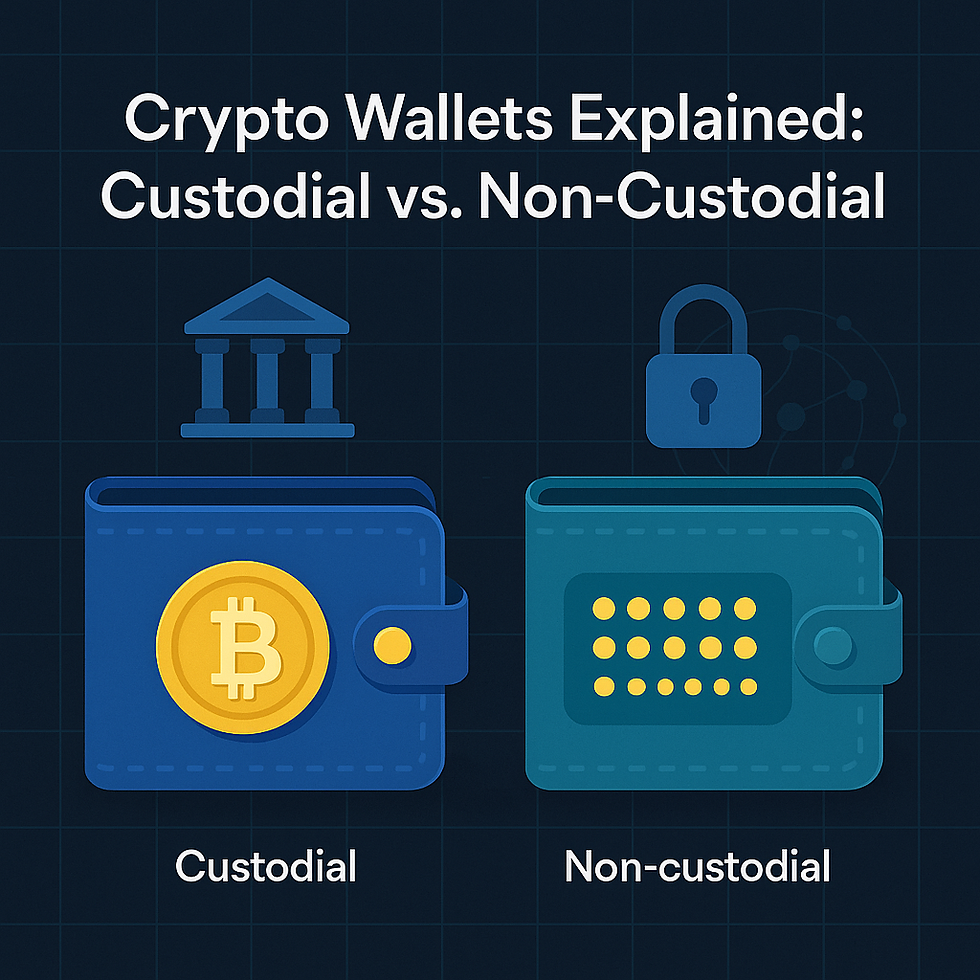
Custodial Wallets: Convenience With Trade-Offs
Custodial wallets are operated by centralized platforms such as exchanges or financial service providers. These platforms maintain the private keys on behalf of users and offer integrated tools for trading, asset management, and conversion.
How Custodial Wallets Work
The user creates an account linked to personal data.
Identification procedures (KYC/AML) are typically required.
The provider stores the private keys and manages the infrastructure.
Limitations and Risks
While custodial solutions are widely used due to convenience, they pose structural risks from a crypto-security perspective:
The provider can freeze accounts or restrict access.
Funds may be affected by platform policies, sanctions, or internal failures.
Users do not maintain direct control over private keys.
Custodial wallets are often used for purchasing assets before transferring them to non-custodial environments for long-term storage.
Non-Custodial Wallets: Full Control of Digital Assets
Non-custodial wallets represent the foundation of decentralized finance and Web3 engineering. These wallets give users complete control over private keys and blockchain interactions, without intermediaries.
How Non-Custodial Wallets Work
No personal identification is required for wallet creation.
The user receives a mnemonic phrase (12 or 24 words), which acts as the recovery key.
Transactions are signed directly on the device or software used.
Examples include MetaMask (for Ethereum-based assets), Bitcoin Core (for BTC), and hardware wallets such as Trezor.
Security Considerations
Because users maintain full control, protecting the mnemonic phrase is essential:
Anyone with access to the phrase can access the funds.
Loss of the phrase often means irreversible loss of assets.
Best practice is to store recovery phrases offline and across secure physical locations.
Types of Crypto Wallets: Beyond the Basic Classification
Beyond custodial and non-custodial distinctions, wallets can be further categorized within blockchain infrastructure and digital asset systems:
Single-Currency Wallets
Designed for one blockchain (e.g., Bitcoin-only wallets).
Multi-Currency Wallets
Support multiple networks and tokens (e.g., Ethereum, stablecoins, altcoins).
These wallets are essential for interacting with decentralized applications, token development environments, and smart contract systems.
Understanding these options is crucial for engineers, businesses, and organizations planning to integrate blockchain development, token issuance, Web3 infrastructure, or decentralized application deployment.
Which Wallet Type Do You Need?
For interaction with the broader crypto ecosystem — including decentralized finance, smart contract platforms, or enterprise blockchain solutions — a non-custodial wallet is essential. Many users maintain multiple non-custodial wallets to separate assets, reduce risk, and improve operational security.
The next steps involve:
Creating a secure non-custodial wallet
Understanding safe storage and mnemonic protection
Buying cryptocurrency and transferring it to controlled addresses
These components form the foundation of long-term digital asset management and secure participation in Web3.
These materials are created for information only and do not constitute financial advice.


Good technical framing. This makes it clear why custodial wallets are convenient but introduce trust assumptions.